
John 1:29-42
29The next day he saw Jesus coming toward him and declared, “Here is the Lamb of God who takes away the sin of the world! 30 This is he of whom I said, ‘After me comes a man who ranks ahead of me because he was before me.’ 31 I myself did not know him; but I came baptizing with water for this reason, that he might be revealed to Israel.” 32 And John testified, “I saw the Spirit descending from heaven like a dove, and it remained on him. 33 I myself did not know him, but the one who sent me to baptize with water said to me, ‘He on whom you see the Spirit descend and remain is the one who baptizes with the Holy Spirit.’ 34 And I myself have seen and have testified that this is the Son of God.” 35 The next day John again was standing with two of his disciples, 36 and as he watched Jesus walk by, he exclaimed, “Look, here is the Lamb of God!”
37 The two disciples heard him say this, and they followed Jesus. 38 When Jesus turned and saw them following, he said to them, “What are you looking for?” They said to him, “Rabbi” (which translated means Teacher), “where are you staying?” 39 He said to them, “Come and see.” They came and saw where he was staying, and they remained with him that day. It was about four o’clock in the afternoon. 40 One of the two who heard John speak and followed him was Andrew, Simon Peter’s brother. 41 He first found his brother Simon and said to him, “We have found the Messiah” (which is translated Anointed). 42 He brought Simon to Jesus, who looked at him and said, “You are Simon son of John. You are to be called Cephas” (which is translated Peter).
Teacher, where are you staying?
Today's Gospel tells us about the transition from John the Baptist's ministry to Jesus' ministry.
John the Baptist is aware that he has faithfully fulfilled his mission as he says, “He must increase, but I must decrease" in John 3:30. John didn't work in vain. He is willing to guide his disciples to follow Jesus, and in doing so, he entrusts the message and his disciples to Jesus.
In verse 29, John is telling about Jesus' identity being the "Lamb of God," and His role of taking away the sins of the world. John refers to Isaiah 53:5-7.
He was pierced for our transgressions, he was crushed for our iniquities;
The punishment that brought us peace was on him, and by his wounds
we are healed. We all, like sheep, have gone astray, each of us has turned
to our own way; and the Lord has laid on him the iniquity of us all. He
was oppressed and afflicted, yet he did not open his mouth; he was lead
like a lamb to the slaughter, and as a sheep before its shearers is silent,
so he did not open his mouth.
The Baptist reveals Jesus' identity as the sacrificial lamb of God offered at Passover and the efficiency of this sacrifice, taking away the sins of the world.
Aware that John’s disciples are following Him (V. 37), Jesus offers hospitality. They remain with Him that day. Where do they go? What does He teach them? What kind of hospitality do they enjoy? The Gospel cares more about the result of this private and privileged time, where we see them proclaiming good news about Him, as Andrew does with his brother Simon, (V 40-42).
May we reflect and meditate on this Gospel. Refresh our convictions about Jesus' identity and mission. Think with St. Paul "This is a faithful saying, and worthy of all acceptance, that Christ Jesus came into the world to save sinners; of whom I am chief” 1 Timothy 1:15.
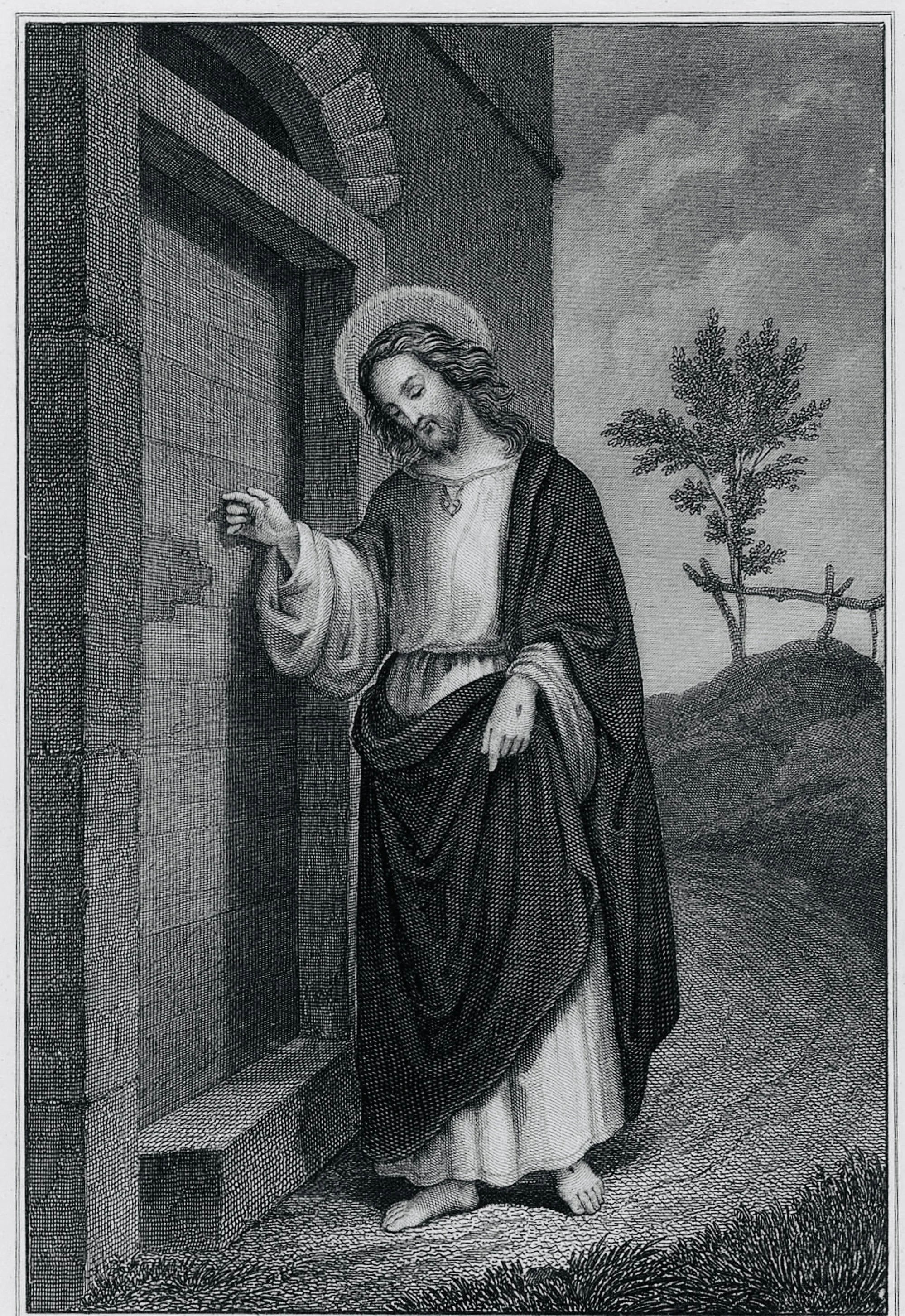
Consider how Jesus turns to invite the two disciples to "come and see” where He stays, the same way He comes and knocks on our doors saying, “Behold, I stand at the door and knock. If anyone hears my voice, and opens the door, I will sup with him, and he with me” Revelation 3:20.
Jesus has the key for eternal life, but we have the keys of our hearts. Happy are those who open their hearts to welcome Him and be His witnesses!