
John 9:1-41
1 As he walked along, he saw a man blind from birth. 2 His disciples asked him, “Rabbi, who sinned, this man or his parents, that he was born blind?” 3 Jesus answered, “Neither this man nor his parents sinned; he was born blind so that God’s works might be revealed in him. 4 We must work the works of him who sent me while it is day; night is coming when no one can work. 5 As long as I am in the world, I am the light of the world.” 6 When he had said this, he spat on the ground and made mud with the saliva and spread the mud on the man’s eyes, 7 saying to him, “Go, wash in the pool of Siloam” (which means Sent). Then he went and washed and came back able to see.
8 The neighbors and those who had seen him before as a beggar began to ask, “Is this not the man who used to sit and beg?” 9 Some were saying, “It is he.” Others were saying, “No, but it is someone like him.” He kept saying, “I am the man.” 10 But they kept asking him, “Then how were your eyes opened?” 11 He answered, “The man called Jesus made mud, spread it on my eyes, and said to me, ‘Go to Siloam and wash.’ Then I went and washed and received my sight.” 12 They said to him, “Where is he?” He said, “I do not know.”
13 They brought to the Pharisees the man who had formerly been blind. 14 Now it was a sabbath day when Jesus made the mud and opened his eyes. 15 Then the Pharisees also began to ask him how he had received his sight. He said to them, “He put mud on my eyes. Then I washed, and now I see.” 16 Some of the Pharisees said, “This man is not from God, for he does not observe the sabbath.” But others said, “How can a man who is a sinner perform such signs?” And they were divided.
17 So they said again to the blind man, “What do you say about him? It was your eyes he opened.” He said, “He is a prophet.” 18 The Jews did not believe that he had been blind and had received his sight until they called the parents of the man who had received his sight 19 and asked them, “Is this your son, who you say was born blind? How then does he now see?” 20 His parents answered, “We know that this is our son, and that he was born blind; 21 but we do not know how it is that now he sees, nor do we know who opened his eyes. Ask him; he is of age. He will speak for himself.” 22 His parents said this because they were afraid of the Jews; for the Jews had already agreed that anyone who confessed Jesus to be the Messiah would be put out of the synagogue. 23 Therefore his parents said, “He is of age; ask him.” 24 So for the second time they called the man who had been blind, and they said to him, “Give glory to God! We know that this man is a sinner.” 25 He answered, “I do not know whether he is a sinner. One thing I do know, that though I was blind, now I see.”
26 They said to him, “What did he do to you? How did he open your eyes?” 27 He answered them, “I have told you already, and you would not listen. Why do you want to hear it again? Do you also want to become his disciples?” 28 Then they reviled him, saying, “You are his disciple, but we are disciples of Moses. 29 We know that God has spoken to Moses, but as for this man, we do not know where he comes from.” 30 The man answered, “Here is an astonishing thing! You do not know where he comes from, and yet he opened my eyes. 31 We know that God does not listen to sinners, but he does listen to one who worships him and obeys his will. 32 Never since the world began has it been heard that anyone opened the eyes of a person born blind. 33 If this man were not from God, he could do nothing.” 34 They answered him, “You were born entirely in sins, and are you trying to teach us?” And they drove him out.
35 Jesus heard that they had driven him out, and when he found him, he said, “Do you believe in the Son of Man?” 36 He answered, “And who is he, sir? Tell me, so that I may believe in him.” 37 Jesus said to him, “You have seen him, and the one speaking with you is he.” 38 He said, “Lord, I believe.” And he worshiped him.
39 Jesus said, “I came into this world for judgment so that those who do not see may see, and those who do see may become blind.” 40 Some of the Pharisees near him heard this and said to him, “Surely we are not blind, are we?” 41 Jesus said to them, “If you were blind, you would not have sin. But now that you say, ‘We see,’ your sin remains.
Healthy Eyesight and Sharp Insight
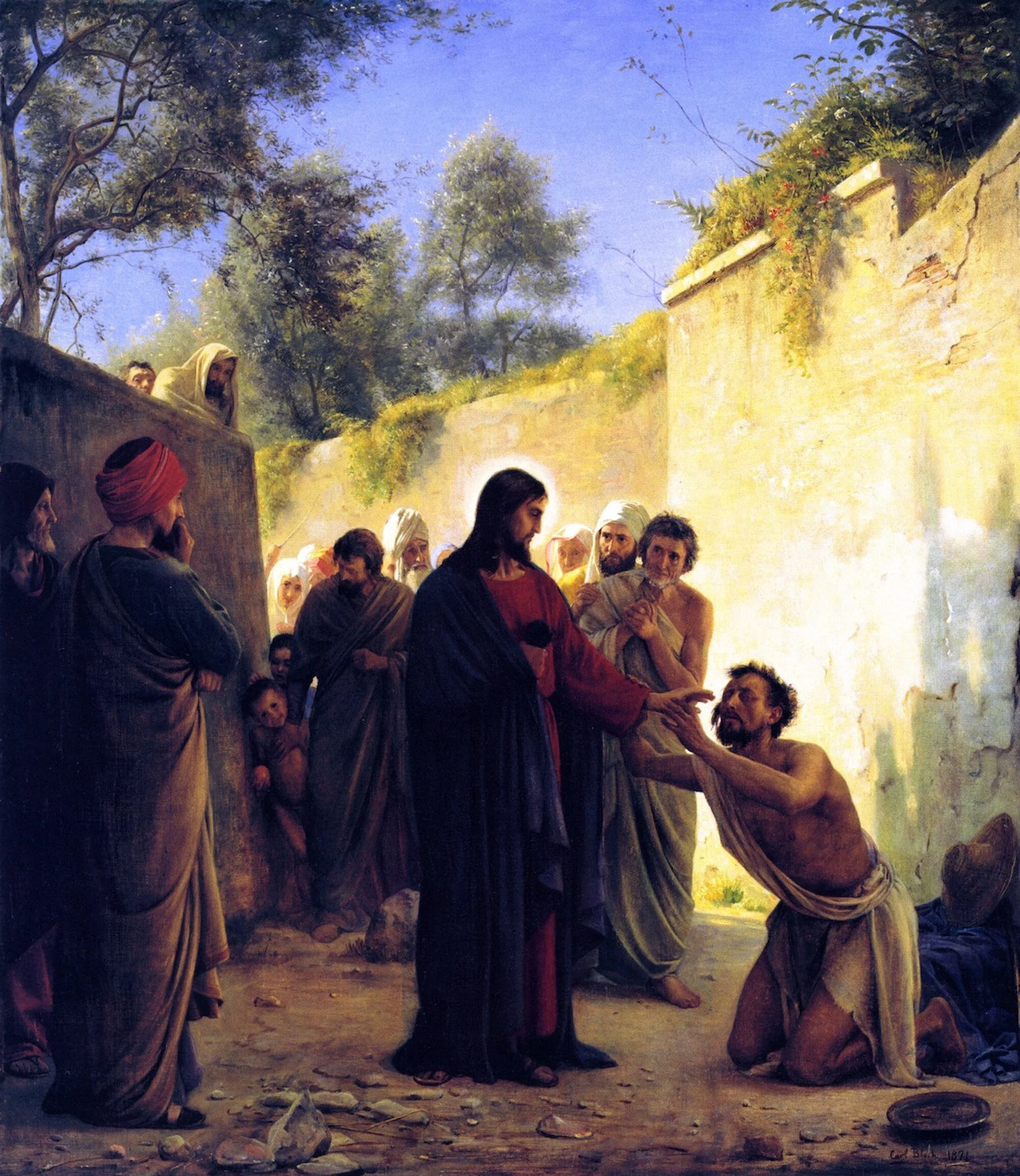
We have already seen Jesus performing many healings of the blind, deaf, lepers, the lame, those possessed by evil spirits, and many other diseases upon the requests of those who believe that He is the Messiah. This time, the healing of the blind man in Jerusalem is a sign and a message with major meanings that Jesus conveys to His disciples, to the religious authorities, and to different spiritual and political groups in Israel.
Among the many important values that can be extracted from this Gospel are:
Jesus' response to His disciples that diseases are not a punishment of a personal or inherited sin (V. 3).
Faith includes personal effort to fulfill its potential, like the blind man who obeyed Jesus as he went down, taking the steep descent to the pool of Siloam.
Jesus sent the man to that pool where the surrounding inhabitants were expecting the Messiah to come from their own community, fulfilling the prophecy of Isaiah 35:4-5, "Behold, your God will come...He will come to save you, then the eyes of the blind shall be opened, and the ears of the deaf shall be unstopped."
Seeing that the prophecy of Isaiah was realized, they should believe that the Messiah is among them, "Your God is among you!" (Isaiah 35).
The pool of Siloam, where the Canaanite city of Jerusalem was founded and where Abraham met King Melchizedek and received his blessing, nourished the kings' gardens in Jerusalem.
The blind man going to Siloam, which means extension or message or sent, became himself a message and a messenger sent to the whole area and its population.
The previously blind man regained his dignity and was able to confront the authority of the Pharisees about Jesus' identity.
We can see his gradual witness of faith. First he says, "The man called Jesus" (V. 11), then "He is a prophet" (V. 17), then, despised and driven out and meeting Jesus who asked him if he believes in the Son of Man, he answers, "Yes Lord, and he worshipped Him" (V. 38).
Jesus, who is light from light, through Him light was created and defeated darkness (John 1:4), regrets how those who are granted eyes to see can deny God's presence, power and acts.
Those who are blind to insight are more afflicted than those who are blind in sight.
May we follow the steps of the healed blind man, and ask Jesus to restore our sight and insight to be able to witness that He is God among us.